
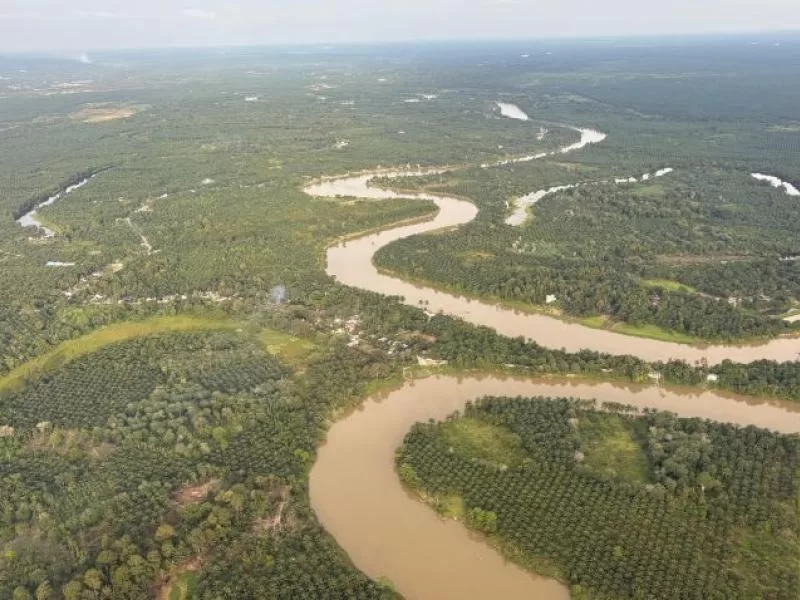
Now, the Indonesian province is charting a different course. With nearly 5.4 million hectares of forest, 4.9 million hectares of peatland, and a growing awareness of the limits of extraction, Riau is betting on a new formula for growth—GREEN for Riau, a province-wide initiative to turn natural wealth into long-term, low-carbon growth.
“GREEN for Riau is the necessity of Riau Province,” says Purnama Irawansyah, Head of the Provincial Development Planning Agency (Bappeda). “Our challenge is to manage our abundant natural resources sustainably for the next generation.”

Riau’s development trajectory mirrors that of many resource-rich regions—high GDP targets driven by extractive industries but fragile ecosystems struggling to cope.
The province’s natural capital is immense: peatlands covering nearly two-thirds of its territory store vast carbon stocks but are also among Indonesia’s most fire-prone landscapes. When drained, they ignite easily, releasing massive emissions. That paradox—wealth and vulnerability intertwined—is what GREEN for Riau seeks to resolve.
The GREEN for Riau Initiative—short for Growing Resilience through Emissions Reductions, Community Empowerment, and Ecosystem Restoration for a Nurturing Future—is funded by the UK Foreign, Commonwealth & Development Office (UK-FCDO). It brings together Indonesia’s Ministry of Environment and Forestry with the Riau Provincial Government, and receives technical support from the UN-REDD Programme, led by UNEP with support from FAO.
The project’s goal is to help Riau qualify for high-integrity jurisdictional REDD+ payments, establishing the legal, technical, and institutional foundations to trade verified emission reductions internationally
GREEN for Riau also directly contributes to Indonesia’s Forestry and Other Land Use (FOLU) Net Sink 2030 target—a national plan to achieve a net absorption of 140 million tonnes of CO₂ per year, equivalent to taking 30 million cars off the road.
The initiative is organized around three interlocking pillars:
- Emissions Reduction: setting provincial forest-emission baselines, rewetting peatlands, preventing fires, and aligning data systems with national MRV protocols.
- Community Empowerment: strengthening social forestry groups, Indigenous institutions, and women-led cooperatives.
- Ecosystem Restoration: rehabilitating peat domes, mangroves, and degraded forests for biodiversity and climate resilience.
“Coordination is key,” says Embiyarman, Acting Head of Riau’s Environment and Forestry Office. “We must build a shared understanding across all sectors about the importance of protecting peat and forests. Without that, our targets will be difficult to achieve.”
Through UN-REDD support, Riau is establishing a benefit-sharing mechanism to ensure at least 80 percent of carbon revenue flows to local communities, Indigenous groups, and local governments.
“Implementation must be supported by research-based data from universities, NGOs, and the field,” explains Dr. Suwondo of the University of Riau. “Only then can we monitor progress and evaluate impact.”
Riau’s academic community plays a growing role in mapping peat depth, tracking biodiversity, and providing evidence for restoration policy. The province is also exploring collaboration with private-sector partners to scale restoration through jurisdictional nesting—aligning corporate projects with provincial MRV and safeguards.
Customary Wisdom and Community Strength
Beyond data and policy, Riau’s transition draws on deep cultural roots. The province’s Malay Customary Council (LAMR), representing Indigenous communities across the province, sees GREEN for Riau as an extension of local wisdom.“Our people live in friendship with nature,” says Marjohan Yusuf, Chairman, Council of the Malay Customary Institute of Riau (LAMR).
“The forest is our grandchildren’s inheritance. If we lose it, our lives and identity will fade as well.”
The initiative formally recognizes customary land-use systems, embedding Free, Prior and Informed Consent (FPIC) into REDD+ processes and integrating Indigenous knowledge into restoration and monitoring. This partnership of science and tradition underpins Riau’s claim to “high-integrity” climate action.
In Siak and Pelalawan, women’s networks such as LPESM and PPSW Riau are helping local cooperatives expand non-timber forest product (NTFP) enterprises—from honey and rattan to mangrove dye and herbal teas.
“Women are often present but not heard,” says Woro Supartinah of LPESM. “We need dedicated spaces where our input shapes decisions.”
“There’s huge potential for women to grow forest-based businesses that strengthen families and forests alike,” adds Herlia Santi of PPSW.
Furthermore, to protect the fire-prone peat and woodlands, the Office of Communication and Informatics (Diskominfotik) is developing Apokesah, a mobile application for citizens to report forest damage and fires directly to provincial authorities. Expanded rural connectivity will also make environmental data and campaign content accessible to remote communities.
“Connectivity itself becomes the gateway for awareness,” says Teza Darsa, Acting Head of Diskominfotik.
That same connectivity is beginning to reshape how forest-dependent communities engage with markets and conservation. As digital tools strengthen vigilance on the ground, they also widen the economic horizon for rural cooperatives that rely on intact ecosystems.
“If the forest stays healthy, our honey business survives,” says Nanang, a honey farmer in Bengkalis. His cooperative employs around 30 people and can produce up to 4 tons a month, but market access remains a hurdle the project hopes to fix through branding and carbon-linked value chains.

Riau’s efforts could unlock hundreds of millions of dollars annually in carbon finance while delivering tangible co-benefits—reduced fires, new jobs, biodiversity protection, and women’s economic inclusion. Peatland restoration alone could cut up to 200 million tonnes of CO₂ annually, positioning the province as a cornerstone of Indonesia’s green-growth pathway

The GREEN for Riau Initiative’s blend of governance reform, customary stewardship, gender inclusion, and carbon-market readiness makes it more than a project—it’s a living prototype of a jurisdictional green economy.